Why Some HDB Owners Never Upgrade — And Regret It Later (2026 Singapore Guide)
- Benjamin Loy

- 2 minutes ago
- 4 min read
One of the most interesting things I’ve noticed after more than a decade in real estate is this:
The biggest property regrets are not always caused by bad decisions.
Sometimes they are caused by:
Decisions that were never made.
Over the years, I’ve met many homeowners who had the financial ability to upgrade.
They had:
✅ Stable income
✅ Healthy CPF balances
✅ Significant HDB equity
✅ Good loan eligibility
Yet they never moved.
Not because they couldn’t.
But because they didn’t.
Years later, many found themselves asking:
“Maybe we should have done it earlier.”
This article isn’t about convincing everyone to upgrade.
It’s about understanding why some homeowners never take action — and why some later regret it.
The Psychology Of Staying Put
Most people assume property decisions are financial.
In reality:
Property decisions are emotional.
People don’t just buy homes.
They buy:
Security
Comfort
Familiarity
Predictability
This is why many homeowners remain in the same property for years, even when upgrading may be financially feasible.
Because staying put feels safe.
The Four Reasons Homeowners Don’t Upgrade
After speaking to hundreds of homeowners, four reasons appear repeatedly.
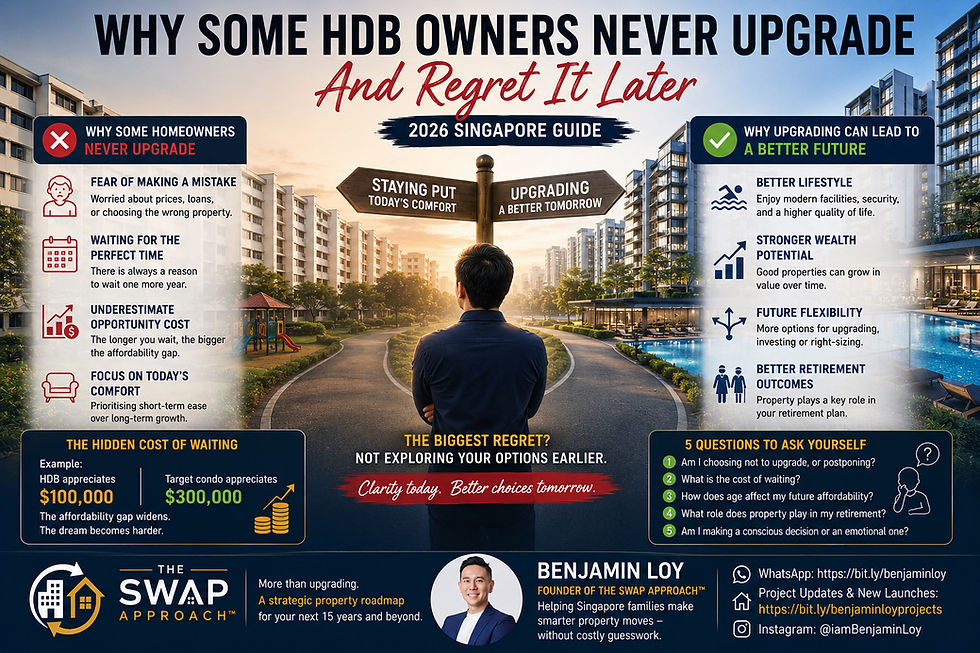
Reason #1: Fear Of Making A Mistake
This is by far the most common.
People worry:
What if property prices drop?
What if I buy the wrong condo?
What if I overpay?
What if my monthly instalment becomes stressful?
These concerns are reasonable.
But sometimes fear becomes paralysis.
The result?
No decision gets made.
Reason #2: Waiting For The Perfect Time
Many homeowners tell themselves:
“Let’s wait one more year.”
The challenge is:
There is always a reason to wait.
Interest rates
Elections
Economic uncertainty
Market headlines
Family commitments
Perfect timing often never arrives.
Reason #3: They Underestimate Opportunity Cost
Most homeowners understand expenses.
Few understand opportunity cost.
For example:
Suppose an HDB appreciates by:
$100,000
During a period where a target condo appreciates by:
$300,000
Both properties went up.
But the affordability gap widened.
This is one of the hidden costs of waiting.
Reason #4: They Focus On Today’s Comfort
Many homeowners optimise for:
Today.
Questions such as:
Can I maintain my current lifestyle?
Will my monthly expenses increase?
are important.
But property planning should also consider:
The next 10–15 years.
The Story Of Two Families
Let’s imagine two families.
Family A
Upgrades at age 40.
They plan carefully.
Choose a suitable property.
Maintain comfortable cashflow.
Allow time for the property strategy to unfold.
Family B
Waits until age 50.
They finally decide to explore upgrading.
But now:
Loan tenure is shorter
Monthly instalments are higher
Property options are fewer
Could they still upgrade?
Yes.
But the path is often more challenging.
Why Regret Usually Appears Later
The interesting thing about property regret is:
It doesn’t happen immediately.
Most homeowners feel comfortable after deciding to wait.
The regret often appears years later.
Usually when they realise:
The move they were considering is now significantly harder.
Or:
The gap between where they are and where they want to be has widened.
Does This Mean Everyone Should Upgrade?
Absolutely not.
Some homeowners should remain in their HDB.
Some are already in the right property for their goals.
Some may prioritise liquidity, retirement or other objectives.
The purpose of this article is not to suggest upgrading is always better.
The purpose is to encourage:
Intentional decision-making.
Not passive decision-making.
The Better Question To Ask
Instead of asking:
Should I upgrade?
Ask:
What am I trying to achieve?
For example:
Better lifestyle?
Better schools?
Retirement planning?
Wealth accumulation?
Future landed aspirations?
The answer often determines whether upgrading makes sense.
The Swap Approach™ Perspective
One reason I created The Swap Approach™ is because many homeowners focus on:
The next property.
Instead of:
The next 15 years.
A property should not be evaluated only by:
Price
Facilities
Location
It should also be evaluated by:
Future flexibility
Wealth potential
Retirement impact
Next-step opportunities
Because upgrading is rarely the end goal.
It is often part of a larger journey.
Real Case Study
A homeowner once told me:
“I wish I had spoken to someone earlier.”
Not because the market moved dramatically.
Not because they made a terrible decision.
But because they never properly explored their options.
They assumed upgrading was out of reach.
When we eventually reviewed the numbers, they discovered:
They could have considered options years earlier.
The lesson?
Sometimes clarity is more valuable than certainty.
Five Questions Every Homeowner Should Ask
Before deciding to stay put, ask yourself:
1. Am I choosing not to upgrade?
Or am I simply postponing the decision?
2. What is the cost of waiting?
3. How does age affect my future affordability?
4. What role does property play in my retirement plan?
5. Am I making a conscious decision or an emotional one?
Frequently Asked Questions (FAQ)
Is upgrading from HDB to condo always the right move?
No. The right move depends on your financial situation, goals and long-term plans.
Why do some homeowners regret not upgrading?
Often because affordability, loan tenure or future opportunities change over time.
Is waiting always a bad decision?
Not at all. Waiting can be sensible when it aligns with a clear strategy. Problems usually arise when waiting becomes the default without proper evaluation.
How do I know if upgrading makes sense?
The answer depends on your CPF, income, equity, family goals and long-term plans.
Final Thoughts: The Biggest Property Regret Is Often Not Exploring Your Options
Most homeowners spend years researching:
Condos
Interest rates
Property news
Yet many never spend time understanding:
Their own possibilities.
Whether you ultimately upgrade or stay put is not the point.
The important thing is making the decision intentionally.
Because after helping many Singapore homeowners over the years, one thing has become clear:
The families who are happiest with their property journey are rarely the ones who guessed correctly.
They are usually the ones who planned properly.
Thinking About Your Next Property Move?
Every homeowner’s situation is different.
Sometimes the best decision is to stay.
Sometimes the best decision is to move.
The key is understanding the numbers, options and long-term implications before deciding.
Benjamin Loy
Founder of The Swap Approach™
Helping Singapore families make smarter property moves — without costly guesswork.
📱 WhatsApp: https://bit.ly/benjaminloy
📩 Instagram: @iamBenjaminLoy
About Benjamin Loy
Benjamin Loy is the Founder of The Swap Approach™, a Singapore property planning framework that helps homeowners transition from HDB to private property, upgrade to higher-value homes, build multi-property strategies and plan towards landed ownership through structured long-term planning.


Comments